Tampilkan postingan dengan label Microsoft. Tampilkan semua postingan

Sabtu, 11 September 2010

Microsof't Funeral

There's really not much fun in bashing Microsoft any more. Although they're still firmly entrenched in the desktop space and profitable as a company, their attempts to make inroads into emerging markets have been less than stellar and in what's arguably the most important emerging market – mobile – they've gone from being a moderately strong player to an almost non-existent fringe player in just a few short years.

You may not believe this, but I'm actually rooting for Windows 7 Phone (though I still hate the name). I really want it to be good, and it has the potential to be good, and even the potential to be better than Android out of the gate. Microsoft's problem has never been lack of good engineers; their problems are almost exclusively management making it impossible for the engineers to deliver something awesome. A lot of Microsoft products have had the potential to be good, but weren't.

But, maybe this is the product that will turn the tide. And if Windows 7 Phone can get some traction, there are a lot of developers out there familiar with C#, .Net, and Visual Studio who will jump aboard their market. I've actually been hearing a lot of good things about the Windows 7 Phone SDK and tools from people. I'm not sure I'd like them - I've never really liked the high-level approach that .NET takes - but a lot of people do, so there's a large pool of potential developers if they can get the platform off the ground.

I'd really love to see the mobile space avoid the quasi-monoculture problems that the desktop space has had thanks to the dominance of Windows. Real competition is good.

So, yeah… I'm kinda rooting for Windows 7 Phone even though I know there's at pretty good chance that Microsoft Management Idiocy™ has ruined another potentially good product. I'm cautiously optimistic based on what I've been hearing from people with access to the tools.

Given that, then, I found yesterday's news of Microsoft's RTM "parade" for Windows 7 Phone very sad. Who throws a victory party before the race has even started? Hell, who even throws themselves a parade?? In the words of Wil Shipley, it's just gauche.

I think the funeral was really for Microsoft's last shred of dignity.

Rabu, 17 Februari 2010

Joy of Tech

Nitrozac and Snaggy seem to have similar views to mine when it comes to design by committee at Microsoft.

Selasa, 16 Februari 2010

Will Windows 7 Phone Be Awesome?

I hope so. Android is falling short of the mark and I'm not sure that the consortium model is capable of producing something better than decent. It's like design-by-committee on a grand scale. But if anybody has the horsepower for a come-from-behind win in the mobile space, it's Microsoft, their previous horrible mobile products notwithstanding.

When you think about the installed base of both Windows and Visual Studio developer tools that will be used to create apps for Windows phones, it's almost embarrassing that Microsoft hasn't done better in this space. Last time I checked, WinMo was down to something like less than 3% of the smart phone market share. Ouch.

But, there's hope on the horizon, it seems. Although the name needs some work, Windows 7 Phone Series looks to have been completely rethunk from the ground up. It doesn't look like Windows (even Windows 7). Gone is the Start Menu and process monitor. Gone are the Windows-style menus. No longer are they trying to take Windows and stick it on a phone. Maybe.

Jesus Diaz of Gizmodo is already declaring the yet-unreleased phone to be better than the iPhone. Of course, a recommendation from the usually-wrong Diaz is about as meaningful as a plug from Rob Enderle. But despite the fact that there's typical Microsoft best-blog-posts-money-can-buy FUD already showing up, there just may be something here. It certainly looks to be a huge step in the right direction at the very least.

I was impressed enough to check out the demo.

Screen shot 2010-02-16 at 9.30.47 AM.png


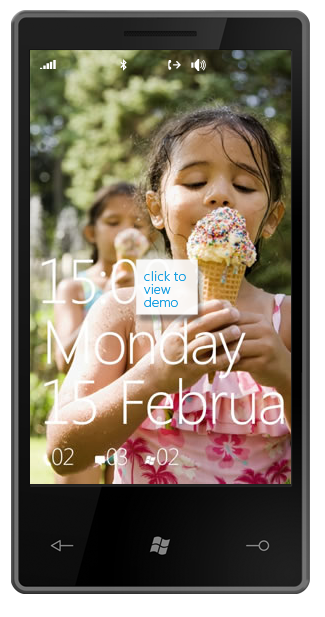
Well, it looks rather iPhone-ish. The corners look a little sharp, and they've committed the same sin as the Nexus one by putting a fricking hardware back button at the bottom. The concept of "back" is context sensitive and not always appropriate, so doesn't belong in a hardware button. Plus, there's some other button whose purpose fails to jump out at me. Perhaps someone at Bletchly Park might have been able to divine the button's purpose, but I doubt it will jump out at the average phone user. Overall, though, it's not a bad concept drawing. It is just a drawing, though, so can't tell too much about the actual hardware. But we can tell a fair bit about the software, so let's look at that.

The first thing that jumped out at me is that they cut off February on the welcome scren. WTF? Is this some stupid attempt to be avante garde, or did they just not fucking notice? Attention to detail counts, remember? Despite the protestations of certain geeks, the iPhone isn't popular because it's elitist or avante garde. In fact, it's quite the opposite. It's popular because it's easy and fun to use. You can't compete by copying the superficialities, even if you are the 800 pound gorilla of the tech world.

But, we're months from release, so I'll cut them a little slack on that one. The next thing I notice - the status bar? Yeah, it's invisible. Which means that the desktop picture shows through behind the status icons. That means the user is responsible for picking a background image that's dark enough for the status bar icons to be legible. Don't leave shit like that to the user, they're bound to screw it up and blame it on you.

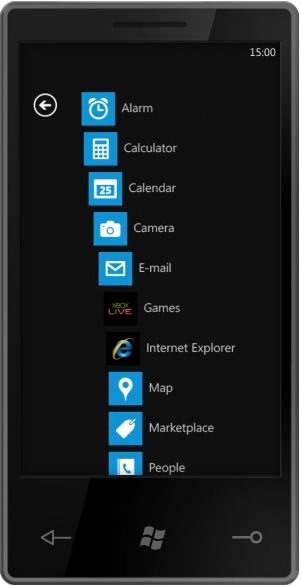
The thing that has Diaz's panties all in a bunch is the task-oriented workflow:

Screen shot 2010-02-16 at 9.47.13 AM.png


I don't get the fascination here. This isn't revolutionary. In fact, these are conceptually muddy buttons. They aren't distinct, and they don't accurately represent the things that a user is going to want to do. Why is Outlook a task rather than an application. It is just an application. Shouldn't it be "E-mail"? And why are Phone and People separate tasks? Who, exactly, are you going to call if not people? And what are you going to do with people if not call, text, or e-mail them? The concept of task-driven may be good, but this implementation of it seems shallow.

I applaud the desire to think differently and do something new, but it's not working here. I can almost visualize the meetings that resulted in this. Some manager from the Outlook group or marketing group insisted that e-mail be re-named Outlook for brand identity or simple ego issues. The Microsoft design-by-committee process is broken. Maybe less broken than it once was, but still broken. It takes good ideas from smart designers and engineers, chews them up, and spit them out as crap. Hopefully pretty crap, but still crap.

But, the Windows 7 Series Phone also has an application-centric view, just like the iPhone! Um, yeah. Great.
Screen shot 2010-02-16 at 10.04.13 AM.png

So, what's next? Ah, yes. Animations. Watch for a second before continuing on.

Okay, so we have eye candy at the press of the button on the main page that causes all the items to animate away. That's kinda cool, but why? What is the purpose? People often accuse Apple of having unnecessary eye candy, but if you look at it, you'll realize that most of it acts as powerful visual feedback. It's usually there to tell you something you might not otherwise notice. In this case, I guess you could argue that it tells you that you've moved to a new page, but that's not really something a user is bound to miss. I can forgive this one as showing off, though. These animations are hard to do right on a mobile phone, so I'll cut them a little slack for wanting to show what they can do in a demo.

But look at the keyboard animation. They take a second to fly in all the individual rows of keys to the keyboard. The first time, you're going to go "Cool!", every other time you're going to say "hurry the fuck up". Animations should never interfere with the user doing the natural thing they want to do. When I tap a text field, I expect to be able to type. Since this screen exists only to let the user search, why isn't the keyboard already being shown when I navigate there? Why do I even need to tap in the text field since it's the only control on the page? Oh, so Microsoft can show off their animations. No. You don't get it, Microsoft. It's not about you. It's about your user. Until you get that, your products will not be as good as they can be.

It's great that the Windows 7 Phone will have the infrastructure to do (hopefully GPU-powered) animations. It really is. Core Animation is the unsung hero of the iPhone's success from a technical standpoint. But it's nothing if not used right. Microsoft's UX team needs to get over the novelty of being able to animate and use the power to do so intelligently. Microsoft is using animation in this demo the way 90% of web designers used bevels and drop shadows in the 1990s, and that's not a compliment.

I know I'm coming across negative, but there's an awful lot of potential in this demo. There's the kernel of a truly remarkable mobile OS here, but you can already see how the design-by-committee is chewing on it.

Microsoft already has a base of developers who will jump on the platform if it's good, and quite a few consumers who will consider it if it's even in the same ballpark as the iPhone in terms of capability and functionality. Perhaps they realize they can shoot for mediocre and do a lot of advertising and FUD and show a profit. I'd really rather they did something truly great.

As it stands right now, I'm not betting on the Windows 7 Phone Series. But… here's my plea to the Microsoft designers and engineers: don't let stupid management decisions screw up what could be a great phone. At Apple, good design and engineering gets pushed and pushed hard from the top down. You don't have that luxury. Your "top" is filled with mediocre management types and your world is filled with bureaucratic in-fighting.

If you want to deliver a great phone, it needs to come from a ground-up revolution. Stick to your guns and fight against stupid decisions. Fight against marketing people making engineering and design decisions. Fight against the rush to get the damn thing out the door fast rather than right. Fight to prove me wrong. Please. You've got the ground floor of something awesome here, but it looks to me like your trajectory is set to completely miss awesome.

Please. Prove me wrong.

P.S. Here's a plea to Microsoft management involved with the phone. Let your people do their fucking jobs and stop second guessing their decisions. Your job should be to protect them from politics, infighting, and other forms of stupidity, not participate in it. Yes, it's a hard job, which is why you get paid more than them.

Kamis, 07 Januari 2010

CES Keynote

Part of my New Year's resolution was not to spend much time on opinion pieces and stick more to programming and technical topics. I can't let last night's disaster of a CES Keynote go without at least a brief comment, however. Watching Steve Ballmer on stage felt like watching QVC, only that comparison does a grave disservice to the QVC sales professionals who actually understand their audience, if not necessarily all the products they sell.


Things go wrong in live presentations, but they don't go as wrong as they did last night unless you really fucking try. It was a fail of epic proportions. From the constant technical problems, like tablets and mobile touch phones not detecting touches, to the use of Twilight to showcase the ability of the "slate" PCs to display eBooks (ZOMG, really? They can do that without a keyboard!?). You're presenting to the Consumer Electronic industry - a room full of geeks and press geeks, and you choose to showcase Twilight? Wow, talk about not knowing your audience.

Now, I know I bash Ballmer and Microsoft more than I probably should, but every year, Ballmer and Microsoft (with the exception of the Xbox division) look more and more buffoonish and less and less relevant. I've said it before, and I'll continue to say it until it happens: Microsoft needs a new leader. They need somebody who really groks technology (Ballmer clearly doesn't) and understands the way people use technology (ditto). The company has a huge number of incredibly talented and smart people. With the right leadership, Microsoft could absolutely knock our socks off and out-Apple Apple.

And that would be awesome for everybody. I can think of nothing better than having Microsoft create truly compelling products across their product lines. But they can't do it the way they are structured and with the present leadership. I'm not saying it would be easy for Microsoft to find the right leader, but almost anybody would be a step in the right direction from where they are now, and the right leader can make all the difference. Look at Apple ten years ago if you doubt that.

Last night's keynote was, quite literally, too painful for me to watch. After a while I just had to turn it off. I don't like watching people embarrass themselves. I really don't, and the press release was already available before the presentation started (oops!), so the salient points could be had without the agony.

Please, Microsoft, please… find a new leader. You owe it to yourselves and your customers to stop this painful decline at Ballmer's ham-fisted hands. Go watch Dr. Ed Catmull of Pixar explain how success masks problems and then find somebody who's got the brains, balls, and sense of showmanship to get you back into a leadership position.

Senin, 09 November 2009

The UI Cockroach

Back in the eighties, during the cold war, the possibility of a nuclear holocaust was a widely-discussed topic in both fiction and casual conversation. As part of that, there was a persistent belief that the one thing that would survive, no matter how bad the nuclear winter, was the lowly cockroach. I have no idea if there's any science behind this belief, but it's a persistent one, seen in popular culture as recently as 2008's Wall•E.

I would like to suggest that a User Interface element that is completely unnecessary and not part of an application's core functionality, yet can't be gotten rid of, be called a UI Cockroach. A shining example of this is the ribbon bar in Word 2008, which is that circa-2001 Aqua-style bar right above the ruler:


You can't get rid of this thing as long as you're in layout view. Although Microsoft has provided literally hundreds of configurable toolbar items that can be reorganized, reconfigured, hidden, combined, and detached in ways that no sane person would ever want or need, somebody at Microsoft made the decision that this monstrosity had to stay on the screen at all times no matter what. Even if you press the lozenge in the upper right of the window's toolbar — the one that hides all the toolbar elements — it still says visible.

And it serves very little in the way of a useful purpose. When you click-it accidentally, you're treated to an absolute abuse of Core Animation. It's animation that serves absolutely no useful purpose. It's there because somebody wanted to do it. I know a lot of Apple-haters think that the animation in Apple's applications are just bells and whistles, but they aren't. WIth few exceptions, Apple uses animation as a visual cue to convey something to the user. Even the much-maligned minimize genie animation serves the purposes of making sure you know where your window went. If it just disappeared, and you didn't already know where minimized windows went, you'd be stuck searching for it. With that animation, you have a visual clue about the fact that it went to the Dock.

The galleries available in the ribbon bar, however, just pop up for no apparent reason. Worse than that, they don't all pop up at the same time, so you lose a few seconds waiting for them all to show up. A few seconds may not seem like much, but if you multiply that by the times you've hit it and the number of people who have, it's not an insubstantial number of seconds that have been wasted by a completely superfluous animation. I'm actually kind of surprised they don't have them all burst into flames when you close the gallery.

I will never, ever use this horrible, horrible ribbon thing. I want that screen real-estate back, and I don't want to ever accidentally be exposed to those horrid document styles or Microsof'ts über-hokey text art again, never mind the silly, superfluous animation that is used to present them.

The only way to describe this is: obnoxious. Well, that's not the only way. I can think of many adjectives that also fit. Ill-advised, ill-considered, and tasteless all work, too.

If anyone knows a way to kill this thing with fire, please, please tell me.

Kamis, 22 Oktober 2009

Nice One, Microsoft

Microsoft opened their first Apple Store today. Wait, no. What I mean to say is that Microsoft opened their first Microsoft Store. That's the ticket. And it's very unique. I can't even imagine where they got the idea for the layout, decor, uniforms or grand opening welcome line. I also can't fathom where they got their inspiration for opening a boutique-style retail store in the first place.

Hey, Redmond? Need a new tagline? How about?

If it's blatant, it's Microsoft.

or, maybe

We do shameless better.

I think either of those would work well, and both would be accurate and honest. Although, in Microsoft's defense, Apple grand openings never have guys in suits at the end of the welcome line golf clapping. That's original.

Rabu, 16 September 2009

Persistence Pays Off

Here's a report that says Microsoft's Bing search engine has captured over 10% of the search market. That's pretty impressive, but when you take into account that Yahoo! search is also powered by Bing, that means the Bing search engine is actually handling 26.7% of search traffic. That's over a quarter of the search traffic being handled by a product that's only existed for four months.

Wow.

That's impressive, phenomenal growth, and Google should be just a little concerned. It'll be a while before Bing has a chance of knocking Google out of its number one position, but they certainly look like they are going to fight the good fight in search now. I bet this number continues to grow for a while, they look to have momentum and are getting almost exclusively good press.

There's no doubt that Bing's presentation is slick and the search engine is capable. It's going to be a lot of fun watching the competition between Google and Microsoft heat up. It will also be interesting to see if Microsoft can get more of their departments to find their groove the way Search has. Maybe they should consider transferring some of Bing's management team over to the Windows Mobile groups.

Jumat, 04 September 2009

Sigh

Microsoft's marketing brain trust continues to look like a 40 year old with a combover trying to look cool at a high school dance.

C'mon Microsoft. You're not selling tupperware or cosmetics. Most sane people aren't going to celebrate a software release that they weren't directly involved in by inviting friends over and playing pin-the-tail-on-the-donkey. Even if you do manage to bribe some people with a free copy of Windows 7 and a chance at fabulous cash and prizes… well, the parties aren't going to look anything like this:


Sheesh. How can a company with so much money and so many smart people working there keep coming up with consistently moronic ideas?

That picture and the advertisement it's part of is a beautiful demonstration of what Jeff Atwood recently blogged about.

Kamis, 20 Agustus 2009

Interesting...

Here's an interesting post on how to get an iPhone-like interface in your WinMo application. It seems like a lot of work to get the functionality you'd get for "free" if you created an iPhone application. My first thought was that I didn't think it was a good sign for the Windows Mobile community that an article like this even exists. It felt like SDK-envy to me.

But then I thought about it some more. As somebody who spent years programming for my non-preferred platform, I really do applaud an effort to work around the limitations of a platform in order to create something that's better, even if it takes a lot more work. I also applaud the willingness to borrow good things from other platforms, as long as the goal isn't to be "as good" as the other platform. Shooting for "as good" never results in greatness, but recognizing that there is a better way can be the first step toward it.

In the long run, maybe it's a really good thing for the WinMo community that you have people who want to create apps with interfaces that are better than the standard WinMo user interface and are willing to put in extra effort to do it. There are definitely signs of life in the WinMo developer community. And, if you think about it, every .Net developer out there is a potential WinMo developer, so with some smart non-Balmer-esque management decisions, Microsoft could capitalize on that base of developers and the apparent desire of at least some of them to create something really good to catapult WinMo solidly back into the fray.

Alas, the chances of any non-Balmer-esque management decisions is not particularly good, but one can hope.

Selasa, 18 Agustus 2009

On iPhone Competitors

At the New York City iPhone Meetup last week, Steve Kochan and I were tasked with talking about the future of the iPhone and the iPhone SDK. I'm not sure either of us were particularly qualified to speak on that. I'm not being modest; I'm not sure anybody outside of One Infinite Loop is qualified to speak about that, and anybody who is qualified is almost certainly not allowed to speak about it. But everybody's got ideas of where things should go and where they might go, so we talked for a little while about some of the things we might see in a hypothetical iPhone SDK 4 or in the next generation of iPhone OS devices.

First of all, I hope nobody took anything I said as gospel. Although I do know a small handful of people inside Apple, none of them are close enough friends that they'd be willing to risk their jobs by giving me secret information, and if any of them did give me secret information, I wouldn't stand up in front of a group of people and spill that secret. I do NOT know what will be coming out when. I don't know if there will be a tablet, or what it will look like. As far as hardware is concerned, I don't know what the future holds at all, and as far as software is concerned, I don't know all that much that hasn't already been made public. I don't know that we'll get garbage collection or, at least, I don't know when we'll get it. I know Apple is capable of delivering a tablet. I highly suspect that they've prototyped several ideas, but Apple prototypes lots of ideas that are never turned into actual products. I know that there are indications of a move toward a completely resolution independent OS, but that's not a secret. Apple has been moving that way for quite some time in the Mac OS, since even before the iPhone OS was forked off.

So, just for the record, anything I said last Thursday night was pure speculation. Do not buy stock based on it, or spread anything I said as if it came from somebody who actually knows something.

And with that out of the way, I noticed that John Gruber has tackled one topic we discussed at the end of the night, which has to do with challengers to the iPhone throne. John's specifically speaking to the Android platform in his posting while we were talking about a handful of platforms, including Palm, RIM, Android, and Microsoft, but a lot of what he says echos what I said during that discussion. And John has a much, much better track record than I do with regard to making predictions about technology and specifically about Apple, so for that part of the discussion, at least, I feel like I was on fairly solid ground.

Kamis, 23 Juli 2009

Interesting Contrast

Definitely a sign of the times: Two days ago, Apple announced another best non-holiday quarter ever, handily beating analysts' predictions. Today, the once-unstoppable Microsoft reported a 17% drop in revenue, marking the first full-year decline in revenue in Microsoft's history and missing analysts predictions by a wide margin.

It's obviously a good time to be a Mac user. It's been a long time since I've heard anyone predict the death of Apple (a favorite pasttime of analysts and pundits for years) and ignorant comments about Macs being "toys" or "not for serious work" are almost non-existent except for a few bitter and lonely commenters on Reddit and Digg.

The problems Microsoft is having, no they are not Microsoft's fault. It's the global slowdown and other things that they have no control over and couldn't have possibly predicted.

Let's face it, Microsoft has "Victim Syndrome". They're not fixing their problems because they haven't truly accepted that they're doing anything wrong. They go so far as to pat themselves on the back for cutting costs and laying people off, saying
In light of that environment, it was an excellent achievement to deliver over $750 million of operational savings compared to the prior year quarter.
Seriously? Operational savings? That's a pussy way of putting it, but I guess "layoffs" sounds too negative. And how does the word "excellent" even get worked into reporting a substantial decline in revenue? And how do they title their release?
The company delivered operational efficiency and innovation in a difficult environment
Now, compare that with Apple's post-Jobs earnings statement from December 2000 where they had some similar problems. Right in the title, they called their results "disappointing". Although Apple pointed out the global PC slump as a contributing factor, the reasons they gave for the loss were that they didn't plan well enough. Apple's approach was, when you cut through the anaylst-speak, to say "we fucked up, we know it, and we're going to fix it". They acknowledged the problem.

Microsoft, on the other hand, is trying to convince everyone (themselves included, perhaps) that they are still headed in the right direction and are doing just great, despite overwhelming evidence to the contrary. What they should be telling us is that they've got problems and they know it, and they've got a plan for fixing those problems.

Microsoft needs an intervention, badly. They need somebody to be a real friend and tell them the harsh truth: that they've got a problem and they need help.

I've said it before, but I think Microsoft is desperately overdue for a change of leadership. It takes a long time to turn a big ship around, so the sooner Microsoft can get someone with vision at the helm, the better it will be for Microsoft.

Microsoft's Ads Redux

A while back, I took Microsoft's new Laptop Hunter series of television advertisements to task for being ill-advised. This line pretty much summed up my point:
Price is the competitive advantage of generic brands and sweatshop-backed superstores.
and this was the crux of my argument:
Now, this [approach] will resonate with some people. There are always people who take a certain pride in buying things cheaply under the assumption that anytime you pay less you get a better value and it's a waste of time comparing the actual products. I doubt that people who think like that are a particularly large percentage of the population. Maybe they are, and maybe this is a brilliant ad, and I'm simply overestimating people. Only time will tell, but I suspect that these ads will help Apple as much as they help Microsoft and, if they have any effect at all, it will simply be to polarize the consumer market even further, giving Apple more of the higher-end, higher-profit sales, and cementing Windows as the operating system of the "cheap" computer. Most people will interpret "just as good" as meaning "not as good".
To the extent that I predicted that Microsoft's ads would not have an impact, I was completely 100% wrong. These ads have almost definitely impacted computer purchasing decisions over the last several months. However, unfortunately for Microsoft, the effect the ads seem to have had is exactly what I predicted. The PC market is getting polarized, with Apple becoming the OS of choice for high-end, high-margin computers.

Microsoft still has overall market share probably in the 80-90% range, which is more than substantial. In fact, it can't be described in any other way than "dominant". There are very few industries where any player has that kind of market share.

But, the bulk of the new computers being sold with Windows on them are sub-$1,000 systems. If you look at the systems being sold in that price range, they are mostly computers with outdated components like slower (and less) RAM and older integrated graphics chips. Now, there are plenty of consumers in this price range, and Microsoft is still making a lot of money from their OEM sales.

But, Apple is now dominating the more lucrative, higher-margin computers, and that dominance has been trending up fairly rapidly.

This is bad for Microsoft in a number of ways. First, the higher the percentage of low-end, basically obsolete computers that there are running Windows, the smaller the potential market for cool new OS-level features in future versions of Windows is. That means that the opportunities for selling higher-margin retail copies of Windows 7 to existing customers (as opposed to those being sold with a new computer) will be considerably less than the installed base. It's also bad for Microsoft's dominance in the PC game industry. One of the most commonly leveled (and perfectly true) accusations against the Mac is that there aren't many games for it. Cutting edge games, however, usually want to leverage the power of the latest and greatest hardware. If 91% of the systems costing $1,000 or more being sold are Macs, don't think game companies aren't going to take notice.

But, the biggest and worst problem for Microsoft is just what I stated above. They're setting themselves up as a generic brand. By competing only on price, and touting only price in their advertisements, rather than the actual technological advantages they do have (and they definitely do have some), their current marketing campaigns are instilling and reinforcing the idea that Microsoft creates bland, mediocre, but affordable and serviceable products. They are basically saying the same thing in their ads as Apple is.

You can argue all day long that your product is better, but if that runs contrary to what you're telling consumers with your marketing, then you're just pissing in the wind. In terms of future sales, it doesn't matter whether Windows is better, it matters whether consumers believe it is better, and Microsoft has stopped telling consumers that.

Senin, 06 Juli 2009

Windows Mobile: World Domination is In Sight!

I broke the five-tweet rule today, which says that if it takes you more than five tweets to say something, it belongs in a blog posting. So, here's my blog posting.

Back in 2007, before the launch of the iPhone, Steve Balmer predicted that Apple had "no chance" of gaining more than 2% or 3% market share. He also predicted Windows Mobile getting to "60%, 70%, or 80%". At that point, Microsoft's two mobile platforms had a total of in the ballpark of a 20% market share and was on a gradual incline.

By February 2008, the iPhone had already overtaken Windows Mobile in terms of Smart Phone market share. That's not even a year later.

This past July, the iPhone overtook Nokia in terms of Smart Phone market share. Although Nokia is still the dominant manufacturer when you look at all phones, that's still impressive. Passing Nokia makes Apple the overall worldwide leader in smartphones! Even more impressive? Those numbers are from Q1, so they don't take into account the between one and two million iPhone 3Gs units that were sold last month. (Note - these numbers are not installed base, they are based on "mobile ad traffic". RIM may still have a larger installed base, but any way you cut it, these numbers are still impressive).

Being a technology pundit is notoriously hard, and I typically cut people slack when they attempt to predict the future, especially when they have an obvious bias such as Steve Balmer has. I mean, we have to expect people to believe in their own products. Of course.

But, here's the thing… Balmer has continuously made bad predictions that directly impact the products that his company offers. Under his watch, they've shipped horrible, horrible products, lost market share in most areas where they compete, failed to establish footholds in any new markets, and are basically slowly bleeding money out of their rectum. They are squandering an almost unsquanderable lead.

Why does this guy still get any respect? I mean, how often does he have to be completely wrong about his job before Microsoft's Board of Trustees gets rid of him and puts in somebody competent? How long can one ship be steered in the totally wrong direction before somebody on-board asks where the hell they're going and if they really should keep listening to their batshit-insane captain?

The HMS Microsoft needs a mutiny. Of course, their Fletcher Christian was probably an orange-badger who got let go once he finished coding to spec.

Note: My bad! I forgot about the Xbox. That shipped under Balmer's watch, makes money, and that team does some good work. Microsoft did, indeed, establish a foothold in the console space and gained considerable market share under Balmer's watch, so I overstated the case there a tad, but I think the overall point is still valid.

Kamis, 23 April 2009

Something to Make Apple Fan-Boys Turn Rhodamine (Pink)

An interesting discussion of someone's first experiences with Microsoft's Surface. I'm honestly a little saddened by this. I think nothing in the world could be better than good competition for Apple's touch-screen products, even if it's not a directly competing product, but if this account is anything to go buy, the Surface doesn't appear to be nipping at Apple's heels in any meaningful way. Oh, the product itself is okay, but the lack of attention to detail... well, it matters! Great technology isn't enough. If you miss the opportunity to wow with the first impression, you've got to fight very hard to get back in the user's good graces.

But, I must admit, there's a very small part of me - the Apple fan-boy part - that secretly smirks with satisfaction that Microsoft is yet again snatching defeat from the jaws of victory in another emerging market.

(via Dr. Wave)

Senin, 06 April 2009

Another Microsoft Ad

Microsoft has another ad in their new series. The message is the same as the previous one: Windows machines are cheaper and therefore a better value. (well, they don't actually reference the operating system in the ad, weirdly enough), In a down economy, this seems like a smart attack. I still don't think these ads are a good approach and after quite a bit of consideration, I really don't think it's just because I prefer Macs. I'm hesitant to revisit this topic, since I don't feel like I did a very good job communicating what I intended to with my previous blog posts about the "Lauren" ads but, what the heck, I'll try again.

Let me clarify something first, though: I don't hate Windows. Prior to coming to full-time Mac and iPhone development work about a year ago, I spent about a decade doing consulting work for very large organizations, primarily big corporations and agencies of the Federal Government. I spent a lot of time using Windows, and am quite comfortable with it. Yes, I prefer Macs. Apple's priorities in terms of design and engineering are much closer to mine than Microsoft's are and in my past life, I spent a lot of time using the unix command line, so the combination means that Mac OS X is by far my favorite operating system. I'm simply not as productive on Windows or using any of the Linux/Unix window managers like Gnome or KDE.

But I don't hate any of them and I'm fully aware that choice of computer and operating system is a very personal decision. I own and have owned many Windows machines over the years and have bought and used machines from most, if not all, of the major PC vendors.

I honestly think these ads are a poor strategy for Microsoft. If you look at what we've been told in the new series of ads, it boils down to this:
  1. Macs are "sexy"
  2. People who use Macs are either cool or elitist depending on how you interpret Lauren's snide remark
  3. You can get a non-Mac computer for less than the cheapest Mac laptop
Now, though this appears to be an ad for HP, it's not. The ad was paid for by Microsoft and is specifically intended to try and counteract the fabulously successful "I'm a Mac" ads. Microsoft has actually come out and said so.

Let me clarify another misconception: I'm not a big fan of "I'm a Mac" ads either. But they're not targeted at me. Neither of these series of ads are targeted at me, but the Apple ads have obviously been very successful. Whether the Microsoft ads will be is yet to be determined, though my bet is that they won't be. Microsoft has certainly created publicity using the famous Dvorak™ method of pissing off the Mac fan-base, but Microsoft really isn't starved for publicity. That's not their problem. That's not why they're losing market share.

Simply put: this is not a strategy befitting or appropriate for a market dominator. And make no mistake, Microsoft is still exactly that in the operating system space. They still hold at least 85% of the desktop computer share. I don't know the exact number, and different sources give different numbers, but I don't believe Mac OS has broken the 10% threshold yet, and I highly doubt Linux has more than 5% of the desktop space. Whatever the actual numbers, there's not even a close second to Microsoft in this market. Apple is a very distant second, Linux (if you lump all the distros together) is an even more distant third. There are few industries where a company enjoys this kind of lead.

But, Microsoft is suffering an identity crisis because the world of computers has fractured into many components, of which the general purpose computer (laptop/desktop) is just one piece, and Microsoft has had a very hard time repeating their dominance in other sectors. While the Xbox is a good gaming console, it has at least two very viable competitors in the PS3 and the Wii. In the MP3 player market, Microsoft has not gained any traction at all with the Zune and it seems like it can only be a matter of time before they give up on it. In the Smart Phone OS market, Microsoft is one of many, and not in first place by any metric.

On top of that, in just a few years, Microsoft had watched Apple climb back from just 2 or 3% market share all the way up to their present location which, by the estimates I've seen, is somewhere between 8 and 10%, which is phenomenal growth. The Goliath that is Microsoft is really, really scared of the David that is Apple. They've watched Apple conquer several emerging markets while Microsoft has, themselves, failed to conquer any new markets over the last several years.

Of course, everybody knows that Vista (after an extraordinarily long development cycle) has not been particularly well received. In fact, it's the butt of many jokes and several of the "I'm a Mac" commercials. Now, I'm no fan of Vista. As a total package, I personally find it to be an inferior experience to even older versions of the Mac OS. The Aero interface feels like a bad knockoff to me - there's lots of gloss caustics and color, but it doesn't feel like much thought went into why they're being used.

But, under the hood, Vista does have some distinct advantages over Leopard. Vista's protected memory, for example, is something security experts laud. It adds a whole level of difficulty in terms of exploiting security flaws like buffer overruns in computer programs. The problem is, the theoretical advantage this provides hasn't turned into a real competitive advantage because Windows viruses, worms, and other malware are still fairly common and Mac viruses, worms and malware aren't. There's occasionally a news report that talks about some trojan or theoretical exploit, but trojans are not viruses and no platform is immune from them. Whatever the reasons, it still remains true that there are very few active exploits in the wild for Mac OS X, so public perception is that the Mac OS X is more secure. And as a practical matter, it still is, regardless of Vista's theoretical advantages.

Plus, good protected memory is not exactly something you can tout to the average non-power-user. So, Microsoft has decided to dumb things down quite a bit and focus on one factor: price. Price is a perfectly valid issue, but I don't think it's a good sign that they've essentially given up trying to tout any other advantages of their flagship product. When Microsoft talks about an OS right now, they talk about the yet-to-be-released Windows 7.

Price is the competitive advantage of generic brands and sweatshop-backed superstores.

It's pretty well-established that television ads serve more than one purpose. One is, of course, to get a certain demographic to buy your product. Another one that is arguably more important for high-ticket item product like cars and computers is to make people feel comfortable with their purchase after the fact. People subconsciously turn to television ads to justify their purchase decisions. In at least some markets like cars and trucks, ads have proven to actually be more effective at this secondary purpose then at getting people to buy in the first place, which is why many car and truck ads tell you nothing substantive about their vehicle, but just show a good looking person doing cool things with the truck. These types of ad help make people feel comfortable with their purchase and foster brand loyalty.

So, first, who is the demographic for this new series of ads? Obviously, it's people who are "not wealthy". It's the middle class, working class, students, and others who are impacted by the downturn in the economy. That's a pretty broad demographic, but Microsoft has actually defined the target audience in the ad: people who want to spend less than $1,000 or $1,500 on a computer. Of course, those are artificial and contrived limits specifically chosen to make a point. But, that's okay - you expect ads to do things like that, and people who refuse to spend more than $1,000 on a computer aren't likely to buy a Mac anyway.

Those people are likely to see these ads after purchasing their new $1,000 computer for validation about their purchase, however. And what's the message that these ads are giving them? That they bought a machine that's neither sexy nor cool. The message of these ads is "hey, at least you got something, right?" These ads tell people they were too cheap to buy a great. well-engineered machine (the new ad even lauds the unibody construction of the MacBooks!), but at least they got an okay machine. Hey, bud, don't you feel great about buying an okay machine?

Now, this will resonate with some people. There are always people who take a certain pride in buying things cheaply under the assumption that anytime you pay less you get a better value and it's a waste of time comparing the actual products. I doubt that people who think like that are a particularly large percentage of the population. Maybe they are, and maybe this is a brilliant ad, and I'm simply overestimating people. Only time will tell, but I suspect that these ads will help Apple as much as they help Microsoft and, if they have any effect at all, it will simply be to polarize the consumer market even further, giving Apple more of the higher-end, higher-profit sales, and cementing Windows as the operating system of the "cheap" computer. Most people will interpret "just as good" as meaning "not as good".

Once you get away from the sensationalism caused by specifically targeting Apple and riling up the fanbase, it seems to me that in the long run, these commercials are horribly misguided. Microsoft is the dominant market leader. They should be focusing on ads that reaffirm that their product is good - and better - and that their product is cool. They should be showing people doing cool things with their products and behaving like other products aren't even worth noticing. They should be touting price as just one of many advantages. They should be acting like, well… a market leader.

Rabu, 01 April 2009

Fundamental Misunderstandings

I really hate bad journalism. Unfortunately, that seems to be the norm these days. Today, Fortune ran an article with the headline How Microsoft Put Apple on the Defensive on its Apple 2.0 blog.

The point of this article is that the Apple faithful are "on the defensive" because of the Lauren commercial. Now, I think it's fair to say I'm one of the "Apple faithful", as are most of my professional and many of my personal acquaintances. I, personally, haven't seen a shred of defensiveness. Moderate amusement and head-shaking? Yeah. More laughs at Microsoft's expense? Sure. A reinforced opinion that Microsoft's marketing team just doesn't "get it"? Well, of couse.

But defensive? Nope. Nobody feels threatened by this at all. It's a silly ad. If you were to do this with any other product, the inherent silliness would be blatantly obvious. Heck, to me, it's blatantly obvious here, but apparently Microsoft and Fortune don't see it.

If you were to, say, offer to buy somebody a free car as long as they could find one under $10,000, and then sent them off to the Lexus dealer, people would laugh in your face. Lexus doesn't try to compete in the sub-$10,000 market, so sending somebody there to look for a sub-$10,000 car is just assinine, and actually going there to test drive a car with a budget of $10,000 is flat-out idiotic.

The first words that jump to my mind when I saw this commercial were "horribly contrived", followed by "passive aggressive" ("annoying redhead" entered my head also, I must admit). If you want to accuse Mac users of being elitists, at least have the balls to come out and say it outright. This pejorative "I'm not cool enough" crap is the kind of thing you'd expect to see out of an unpopular third-grader who didn't get picked first for dodgeball.

Let's be frank: in an economy like this, there is a strong idea at the heart of this ad: if you have a small budget, you can get a decent computer for fairly little money if you don't mind buying technology that is already obsolete and don't mind putting up with Windows and the various,spyware, crapware adware, and other baggage that comes pre-installed on these machines. Acting like a pouty adolescent is hardly the best way to capitalize on that message, however. There are people with whom the underlying message would resonate, but (call me crazy) I really doubt you're going to entice those people by telling them they're not cool and can't afford the stuff that is cool. I know that was meant as a backhanded swipe at Apple, but it's not going to read that way to the iPod generation, many of whom actually do think Apple's products are pretty cool. I mean, other than Steve Balmer's kids, do you know many young people who don't either have or want an iPod?

So, if anyone's being defensive here, it's Microsoft. If you can't focus on what makes your product better and need to resort to childish name-calling of your opponent, then you don't have much confidence that your product is any good. Understandable when your product is Vista, but still, let's be honest about who's on the defensive.

 
Design by Free WordPress Themes | Bloggerized by Lasantha - Premium Blogger Themes | Lady Gaga, Salman Khan